David Larter and Mark D. Faram, Navy Times, Feb 1
A lieutenant embarked for training on board the Bremerton, Washington-based carrier John C. Stennis is under investigation for allegedly trying to record women inside the female officers' bathroom.
It is the second investigation in the past two months into Navy personnel allegedly attempting to film women in the bathroom while underway.
According to a document obtained by Navy Times, the junior officer was caught standing outside the women's bathroom dressed in PT gear with a handheld electronic device held to a ventilation grate "positioned to view the interior of the female head."
When a woman aboard Stennis approached the 33-year-old lieutenant, he is reported to have said "sorry," and left the area.
The woman later identified the lieutenant eating in the wardroom and ship's security seized his personal electronic devices, according to the Navy message released on the incident.
News of the alleged incident on the Stennis comes a month after allegations came to light in the submarine force of a sailor allegedly using a cell phone to video female officers in the shower over a 10-month period onboard the the Kings Bay, Georgia-based ballistic missile submarine Wyoming.
Though up to 12 have been implicated in the alleged submarine incident, no formal charges have yet been brought in the case.
Monday, February 2, 2015


Navy seeks new sub escort station at Port Angeles;concerns raised
KXLY.com, Jan 30
PORT ANGELES, Wash. - The Navy has disclosed plans for a pier and facilities at Port Angeles to support seven vessels that escort Bangor submarines between the Hood Canal and the Pacific Ocean.
The Navy says the $17 million project is needed so that crews from Naval Base Kitsap don't exceed their hours at sea on the screening, blocking and patrol boats.
The Peninsula Daily News reports the Navy is collecting comments on a study of three possible sites on Ediz Hook.
The project has raised concerns from divers who say it would compromise an artificial reef near the dock, Indians who say it could threaten eelgrass beds and Puget Sound Pilots who say it would be too close to their station.
PORT ANGELES, Wash. - The Navy has disclosed plans for a pier and facilities at Port Angeles to support seven vessels that escort Bangor submarines between the Hood Canal and the Pacific Ocean.
The Navy says the $17 million project is needed so that crews from Naval Base Kitsap don't exceed their hours at sea on the screening, blocking and patrol boats.
The Peninsula Daily News reports the Navy is collecting comments on a study of three possible sites on Ediz Hook.
The project has raised concerns from divers who say it would compromise an artificial reef near the dock, Indians who say it could threaten eelgrass beds and Puget Sound Pilots who say it would be too close to their station.
Builder of "beastly drone" used by SEALS acquired by sub builder
Hugh Lessig, Daily Press, Jan 30
Huntington Ingalls Industries Inc., which builds nuclear-powered submarines in Newport News, has acquired a Florida company that designs and constructs unmanned underwater vehicles.
The shipbuilding giant has purchased the Engineering Solutions Division of The Columbia Group, headquartered in Panama City Beach, Fla. The company has 30 employees and builds specialized manned and unmanned undersea vehicles. Its primary customer is the U.S. Navy, but it works for militaries around the world.
HII announced the acquisition Friday in a news release. Engineering Solutions will operate as Undersea Solutions Group, an HII subsidiary. It will report to Newport News Shipbuilding's Submarine and Fleet Support division.
Matt Mulherin, president of Newport News Shipbuilding, said the Florida company's expertise "is a natural extension" of the submarine work that goes on now at Newport News, one of only two U.S. shipyards that builds the nuclear-powered, Virginia-class submarine. The other yard is General Dynamics Electric Boat of Groton, Conn.
Engineering Solutions builds and maintains swimmer delivery vehicles (SDVs) for both U.S. and foreign military use. SDVs can be used by special forces for covert missions.
It designed, developed and operates the Proteus, which operates autonomously as either a manned or unmanned craft. The Proteus was developed in partnership with Battelle Memorial Institute. It used technology from Bluefin Robotics, a subsidiary of Battelle.
In 2012, Proteus was described by Wired Magazine as a "beastly drone" that could further the Navy's goal of developing large, underwater drones that can operate for months on end. It is a 25-foot, cylindrical shaped craft that can carry a pair of 220-pound bombs and 400 pounds of cargo, or six Navy SEALs when running in manned mode, the magazine reported.
The Florida company is also the sole U.S. maker of the Pluto autonomous mine-hunting unmanned underwater vehicle, which it manufactures under a Swiss license for foreign military sales.
Huntington Ingalls Industries Inc., which builds nuclear-powered submarines in Newport News, has acquired a Florida company that designs and constructs unmanned underwater vehicles.
The shipbuilding giant has purchased the Engineering Solutions Division of The Columbia Group, headquartered in Panama City Beach, Fla. The company has 30 employees and builds specialized manned and unmanned undersea vehicles. Its primary customer is the U.S. Navy, but it works for militaries around the world.
HII announced the acquisition Friday in a news release. Engineering Solutions will operate as Undersea Solutions Group, an HII subsidiary. It will report to Newport News Shipbuilding's Submarine and Fleet Support division.
Matt Mulherin, president of Newport News Shipbuilding, said the Florida company's expertise "is a natural extension" of the submarine work that goes on now at Newport News, one of only two U.S. shipyards that builds the nuclear-powered, Virginia-class submarine. The other yard is General Dynamics Electric Boat of Groton, Conn.
Engineering Solutions builds and maintains swimmer delivery vehicles (SDVs) for both U.S. and foreign military use. SDVs can be used by special forces for covert missions.
It designed, developed and operates the Proteus, which operates autonomously as either a manned or unmanned craft. The Proteus was developed in partnership with Battelle Memorial Institute. It used technology from Bluefin Robotics, a subsidiary of Battelle.
In 2012, Proteus was described by Wired Magazine as a "beastly drone" that could further the Navy's goal of developing large, underwater drones that can operate for months on end. It is a 25-foot, cylindrical shaped craft that can carry a pair of 220-pound bombs and 400 pounds of cargo, or six Navy SEALs when running in manned mode, the magazine reported.
The Florida company is also the sole U.S. maker of the Pluto autonomous mine-hunting unmanned underwater vehicle, which it manufactures under a Swiss license for foreign military sales.
Atlantic magazine raves about "Black Sea"
Kevin McDonald's submarine thriller may not be a masterpiece, but the Jude Law-led genre movie stands out at a time when very little else at the multiplex does.
Read the full review in The Atlantic at http://www.theatlantic.com/entertainment/archive/2015/01/black-sea-a-solid-submarine-thriller-for-winter-doldrums/384994/
Lax rules on cell phones cited in Navy video scandal
A dozen male sailors are waiting to see whether they'll be charged for recording, distributing or not reporting videos of their female shipmates in a submarine's shower changing area for over a year. And one suspect's attorney is building a defense based, at least in part, on the contention that personal electronics rules aboard a sub are muddy and unevenly enforced.
Attorney James Stein, based near Kings Bay in Camden County, Georgia, contends that not only is the PED instruction confusing, most sailors and officers don't follow it.
"My information is that the use of the devices was widespread among most of the crew, officers included," he told Navy Times in a Jan. 16 phone interview. "I also have information that by the time the sub hit the docks, officers and enlisted men were using the devices."
It is the first sign of a possible defense in the high-profile case. A Navy official confirmed to Navy Times in December that investigators suspected seven videos had been taken with a cell phone camera aboard the Kings Bay, Georgia-based ballistic missile submarine Wyoming.
Attorney James Stein, based near Kings Bay in Camden County, Georgia, contends that not only is the PED instruction confusing, most sailors and officers don't follow it.
"My information is that the use of the devices was widespread among most of the crew, officers included," he told Navy Times in a Jan. 16 phone interview. "I also have information that by the time the sub hit the docks, officers and enlisted men were using the devices."
It is the first sign of a possible defense in the high-profile case. A Navy official confirmed to Navy Times in December that investigators suspected seven videos had been taken with a cell phone camera aboard the Kings Bay, Georgia-based ballistic missile submarine Wyoming.
Sunday, February 1, 2015
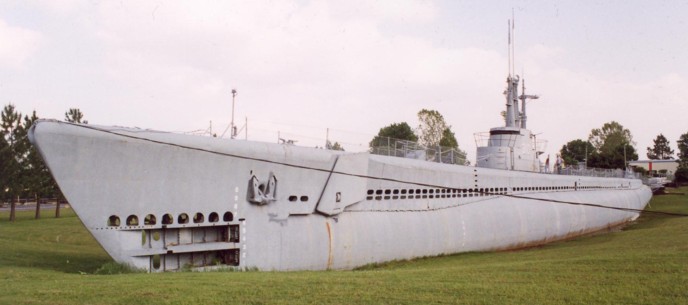
"Crew" to reassemble on famed WWII sub to mark 70th anniversary of record-setting USS Batfish
The crew of the World War II USS Batfish will live again aboard the famed submarine Friday (Feb. 6) and Saturday at Muskogee’s War Memorial Park. Dressed in reproduction World War II uniforms, up to 30 volunteers from a four-state area will portray crew members from the cook to the captain, said Corey Twilley, president and founder of the Batfish Living Historical Association.
Twilley is a military historian/curator for the Department of Army at Fort Still. He’s also captain of the USS Batfish. “Our goal is to educate the younger generation. This allows school kids a chance to catch a glimpse of what life was like aboard a World War II submarine 70 years ago,” Twilley said. The guided tours will last about 90 minutes, and visitors can interact with crew members who will answer their questions. “We eat, sleep, breathe and live on the Batfish, leaving just to go to the bathroom,” Twilley said. “All cooking is prepared in the galley, and we’ve gone so far as to reproduce the plates that everyone eats off of.” The “silent service” (submariners) ate better than any other group in the military in the 1940s, partially because of the conditions they had to live in and go through, Twilley said. “Warfare for them was completely different. Rarely did you ever see your enemy. You were constantly playing cat and mouse,” he said. “There were very few Purple Hearts in the silent service. You came back with everyone or no one came back.” February is the 70th anniversary of the USS Batfish breaking the world record for sinking 3 Japanese submarines in a single day. Below is the submarine at rest in the city's park as a monument.
Russia offering India cutting-edge stealth submarines
 A Russian design bureau, Rubin, is running tests on AIP systems to be installed on the Russian Navy's Lada-class diesel-electric submarines (Project 677) in 2015, with a new class of non-nuclear submarines with AIP engines to enter the construction phase in two years. |
Russia could supply the Indian Navy with "stealthy" submarines, equipped with air-independent propulsion (AIP) systems if India opens a tender for them, a senior official at Russia's Federal Service for Military-Technical Cooperation told RIA Novosti recently..
"The Russian side is ready to supply a foreign client with a submarine refitted to meet any requests for a different exterior and equipment as formulated by the client," the source told RIA Novosti.
In 2007, New Delhi said it was considering expanding its fleet of submarines with diesel-electric subs. One of the key requirements was for the boats to have so-called anaerobic engines.
Air-independent (closed cycle) submarines, which usually use hydrogen-oxygen fuel cells, are quieter than conventional diesel-electric boats and do not have to surface or use snorkel tubes to breathe air, thereby exposing themselves to detection by radar and other sensors.
A Russian design bureau, Rubin, is running tests on AIP systems to be installed on the Russian Navy's Lada-class diesel-electric submarines (Project 677) in 2015, with a new class of non-nuclear submarines with AIP engines to enter the construction phase in two years.
"The Russian side is ready to supply a foreign client with a submarine refitted to meet any requests for a different exterior and equipment as formulated by the client," the source told RIA Novosti.
In 2007, New Delhi said it was considering expanding its fleet of submarines with diesel-electric subs. One of the key requirements was for the boats to have so-called anaerobic engines.
Air-independent (closed cycle) submarines, which usually use hydrogen-oxygen fuel cells, are quieter than conventional diesel-electric boats and do not have to surface or use snorkel tubes to breathe air, thereby exposing themselves to detection by radar and other sensors.
A Russian design bureau, Rubin, is running tests on AIP systems to be installed on the Russian Navy's Lada-class diesel-electric submarines (Project 677) in 2015, with a new class of non-nuclear submarines with AIP engines to enter the construction phase in two years.
Subscribe to:
Posts (Atom)