Kalyan Ray, Deccan Hearld
30 March 2015
Project Varsha, India's secret nuclear submarine base on the east coast, has received less than 15 per cent of its approved budget in the current fiscal, adversely affecting its development.
Being constructed at Rambilli, near Vishakhapatnam, the base received a meagre Rs 26 crore in 2014-15 as against the budgetary allocation of Rs 197 crore, sources told Deccan Herald.
The government took away almost Rs 13,000 crore from the Defence Ministry's budge in the current fiscal. This closely-guarded naval facility is one of the projects that faced the consequences.
Finance Minister Arun Jaitley, who held the defence portfolio for a few months, has now made an allocation of Rs 531 crore in the 2015-16 budget for the submarine pen, which may be named INS Varsha, when commissioned. China has a similar base in the Hainan Islands.
The slashing of the budget, however, has made Navy officials apprehensive about timely completion of the strategic project.
Though the base's construction began in 2009, the first major cash flow took place in 2011, when the Navy received almost Rs 160 crore, out of which Rs 58 crore was meant for civil construction and the rest for the communication system of the base.
Since then, Project Varsha was getting a steady supply of funds—it had received Rs 547 crore in 2013-14—before it was struck by cash shortage.
India operates two nuclear-powered submarines—the Russian origin INS Chakra and the indigenous INS Arihant.
While two more indigenous nuclear-powered and ballistic-missile-tipped submarines are under construction, New Delhi and Moscow are negotiating for a second Russian nuclear submarine.
INS Varsha would be accompanied by a weapon storage facility called “missile technical positions” (MTP).
It was also impacted by the budget cut, but to a lesser extent as the budgetary estimate of Rs 237 crore was reduced by Rs 100 crore.
Jaitley has now promised Rs 137 crore for the MTP, which reduces the operational turnaround time in wartime situations.
The finance crunch comes at a time when China is increasingly flexing its military muscle in the Indian Ocean.
After India's outrage over Chinese conventional submarines being refuelled in Sri Lanka, China's People's Liberation Army Navy is now increasingly instructing its nuclear-powered submarines in the Indian Ocean to avoid surfacing at all, said a navy officer.
India has readied a brand new very-low-frequency transmitting station on the Tamil Nadu coast, and installed an ultra-high-frequency transponder on its military satellite GSAT-7 for talking to submarines underwater.
Monday, March 30, 2015


Future U.S. Navy: Robotic sub-hunters, deepsea pods
Dan De Luce, Agence France-Presse
27 March 2015
The robotic revolution that transformed warfare in the skies will soon extend to the deep sea, with underwater spy "satellites," drone-launching pods on the ocean floor and unmanned ships hunting submarines.
Officials at the U.S. military's research agency outlined new programs this week that include a number of potentially groundbreaking technologies that could alter the way naval battles are fought, in the same way that robotic aircraft have altered warfare on land and in the air.
One proposed system envisages robot pods on the ocean floor that would be activated when needed.
The pods could launch surveillance drones in the air or at sea or provide a communications link when American forces are facing electronic jamming, said Jared Adams, spokesman for Defense Advanced Research Projects Agency (DARPA).
"The motivation is to enable timely deployment of unmanned distributed systems to distant locations by pre-deploying the assets years in advance and then triggering their release for rapid effects at future times of our choosing," Adams told AFP.
The program has been dubbed "Upward Falling Payloads," or UPF. And officials said the robot pods floating to the water's surface to release various payloads could perform some roles now carried out by submarines, which are much more expensive to operate.
With America's technological edge shrinking, researchers are looking at how to create and build new weapons quickly, instead of the drawn-out process that usually prevails at the Pentagon.
DARPA Deputy Director Steven Walker said the agency is "rethinking how we develop new military systems" to be more agile and "cost-effective."
"Some of our systems today are extremely capable, the most capable in the world, but they are very complex, they are costly. They take a long time to develop and field," he said.
The UPF program of undersea pods poses serious technological challenges, including how to trigger the launchers, how to make them rise to the surface and how to secure a power supply deep under the ocean for more than a year at a time, Walker said.
DARPA, known for breakthrough experiments over the years that helped create the Internet, stealth aircraft, drones, "smart" bombs and micro-technologies, is also keen on some other maritime research.
One program envisages spying "eyes" on the ocean floor, including mobile and fixed systems, that would act as satellites or "sub-ulites," allowing the U.S. military to spot other countries' submarines.
Researchers with the Distributed Agile Submarine Hunting (DASH) expect the "sub-ulites" would have "a detection envelope that's pretty broad," Walker said.
DARPA's scientists also are working on passive sonars deep under sea that would listen out for the "acoustic signatures" of submarines.
Another maritime program at DARPA is moving closer to reality, potentially revolutionizing submarine warfare.
The project would deploy unmanned vessels on the ocean's surface to track enemy submarines, a "ghost ship" that could free up naval warships for other tasks.
Sub-hunting is a notoriously time-consuming and expensive task, particularly diesel submarines that have extremely quiet engines.
If the project succeeds, it could prove a "game-changer" for the navy, officials said.
The program, known as ACTUV or Anti-submarine Warfare Continuous Trail Unmanned Vessel, is developing a 132-foot (40-meter) robotic boat dubbed the "Sea Hunter."
A smaller experimental vessel recently passed a key six-week test in waters off Mississippi without crashing and the next test with a full-sized prototype will reportedly attempt to follow another boat at a 0.6-mile (one-kilometer) distance.
"The navy is working with us to do a sea trial in the fall," Walker said.
The system is relatively inexpensive compared to the cost of a modern submarine, but offers a potentially effective way to track an enemy's sub.
"It's basically turning the cost equation on its head," Walker added.
Portsmouth Naval Shipyard prepares for surge of employment at sub maintenance base
Workforce at highest level in 20 years
Deborah McDermott, Portsmouth (NH) Herald
29 March 2015
Portsmouth Naval Shipyard, already the largest employer in the Seacoast, is infusing the area with millions of new dollars as it hires more than 700 workers to handle an ever-increasing demand for submarine maintenance work and to replace an aging workforce.
As the shipyard enters its 100th year of submarine work in 2015, the yard could not be busier, with two submarines currently undergoing a maintenance overhaul and a third going through the decommissioning process.
The additional workers – most of them young and starting out in their work life – are well paid. Typical pay for apprentice workers at the yard is $17.50 an hour; beginning engineers with college degrees can expect to earn $45,400.
And they are a boon to the local economy, said Doug Bates, president of the Greater Portsmouth Chamber of Commerce.
“This is a great opportunity for our young people,” he said. “They can stay in their home state, get a very good paying job and be in the place they love. We can’t turn the economy around with low-paying jobs, because people can’t afford to live here. These are exactly the kinds of jobs we need.”
PNSY in 2013 had a combined civilian payroll of more than $414 million, according to the most recent shipyard economic impact report by the Seacoast Shipyard Association.
The shipyard will be hiring a total of 715 workers by Sept. 30 of this year, and has already brought on 415 people since October. The vast majority – about 470 in all when hiring is complete – will be apprentice workers. Many of the remaining workers will be skilled engineers, as well as administrative personnel.
When hiring is complete, 5,200 will work for Naval Sea Systems Command at the shipyard, supporting its submarine maintenance and availability work. (Another 800 people work at the shipyard but not for NAVSEA Command.) It’s a net gain of about 500 new jobs, said shipyard commander Capt. William Greene. About 200 workers are replacing retiring workers.
“I think we are very well positioned to be stable if not growing into the future," Greene said. "We certainly have plenty to keep 5,200 people occupied."
Paul O’Connor, president of the Metal Trades Council at the shipyard, said the growing workforce is "another shot in the arm for the Seacoast economy.”
“It’s huge," he said. "We’re infusing 715 people into our regional workforce, people who make good pay. We’re increasing our NAVSEA workforce by about 15 percent in one year. That’s unbelievable."
The new workers represent a commitment by the U.S. Navy not only to Portsmouth, but to all four public yards. During the fiscal year that ends Sept. 30, Norfolk Naval Shipyard in Virginia will be hiring 1,500 workers; Puget Sound in Washington state, 850; and Pearl Harbor, 731, according to the Navy.
“For the Navy, one of its very top priorities is to maintain the ability for forward deployment” of its fleet, said retired Adm. Peter Daly, chief executive officer of the U.S. Naval Institute. “I see them as committed to the path of hiring at the shipyards this fiscal year, and I predict that if there are future budget cuts, it will be a priority to defend these jobs.”
The Navy gives two primary reasons for the new hires at the four shipyards. Adm. Jonathan Greenert, in testimony before the Senate Armed Services Committee earlier this year, said sequestration in 2013 caused a $9 billion shortfall in the Navy’s budget. One of areas that suffered as a result of those cuts were ship and aircraft maintenance – although mostly work on surface ships suffered. One casualty of those cuts, however, was USS Miami, which was set afire by a PNSY worker. It was to be repaired, but instead was mothballed due to cost.
“Shipyard maintenance work is tightly wound, complex work,” Daly said. “Right now, not all shipyards are keeping up with start dates and end dates of availabilities. They need to catch up with that.”
O’Connor said Portsmouth Naval Shipyard, however, prided itself on working through those budget cuts and getting its work out on time.
“Sure, some of that work got backed up, but we managed to plug and plod our way through that era. Every boat we had in the shipyard even then at the very least got out on time and on budget,” he said.
A big reason for that is the Structural Shop Learning Center at the yard, which simulates a real-life submarine. Apprentices train there and then go on to the actual sub after they’ve gained the skills. According to O’Connor, the center allows apprentices to get onto the subs faster, and reduces incidents of mistakes or workforce accidents on the sub itself.
“We’re training our folks up much quicker than we used to. We did it as a matter of necessity, but it works," he said. "The quicker we can get them trained, the faster we can get them out to the boats. If we didn’t do that, we’d be in a world of hurt.”
The situation is made more urgent because there are proportionally few mid-life workers at the yard due to a hiring freeze in the mid-1990s, said O’Connor, and more and more retiring workers.
Unlike in the private sector, it can take up to five years to fully train a new employee at the shipyard.
“It takes years to be totally proficient in any given trade," O'Connor said. "There’s a lot of complexity in nuclear sub repair and modernization. The demographics are such that a lot of folks are retirement eligible and we have to replace them, but we need time to train those new folks.”
Greene said the yard is expected to hire enough new workers in the future to cover those who are retiring each year and perhaps even slightly more. The yard has a full workload of scheduled work for at least the next 5 to 8 years, he said.
“What I know is that we have plenty of work to keep our folks busy for the next several years, and we’ll be hiring folks to make sure we can meet our increased workload,” he said.
Neil Rolde of York, Maine, past chairman of the Seacoast Shipyard Association, said he’s encouraged by the new jobs, saying the Navy’s decision to increase the yard’s workforce “is about as good as any commitment a governmental agency can make.”
“But it can always change," Rolde warned. "That’s why we keep the organization together. From everything we can see, things are going well at this particular point. But we’ll be forever vigilant.”
U.S. Navy rolling out undersea spy satellites
Aiswarya Lakshmi, Marine Technology
29 March 2015
The robotic series that remade crusade in skies will shortly extend to a low sea, with underwater view “satellites,” drone-launching pods on a sea building and unmanned ships sport submarines, reports AFP.
The pods could launch surveillance drones in the air or at sea or provide a communications link when American forces are facing electronic jamming, said Jared Adams, spokesman for Defense Advanced Research Projects Agency (DARPA).
Adam said that the proclivity is to capacitate timely deployment of unmanned distributed systems to apart locations by pre-deploying a resources years in allege and afterwards triggering their recover for fast effects during destiny times of a choosing.
DARPA is working on a new system that can be used by the US military, more reliable than GPS. The US government wants a more dependable real-time position tracking technology, seeking something that is unable to be jammed and won't have blind spots.
American researchers are looking during how to emanate and build new weapons quickly, instead of a drawn-out routine that customarily prevails during a Pentagon.
DARPA, famous for breakthrough experiments over a years that helped emanate an Internet, secrecy aircraft, drones, “smart” bombs and micro-technologies, is also penetrating on some other nautical research.
DARPA’s Anti-Submarine Warfare (ASW) Continuous Trail Unmanned Vessel (ACTUV) program seeks to develop a new type of unmanned surface vessel that could independently track adversaries’ ultra-quiet diesel-electric submarines over thousands of miles.
One of the challenges that the ACTUV program is addressing is development of autonomous behaviors for complying with the International Regulations for Preventing Collisions at Sea, known as COLREGS. Substantial progress has been made in developing and implementing those behaviors. Currently, ACTUV’s system for sensing other vessels is based on radar, which provides a “90 percent solution” for detecting other ships.
However, radar is less suitable for classification of the type of other vessels, for example determining whether the vessel is a powered vessel or a sailboat. Additionally, one of the requirements of COLREGS is to maintain “a proper lookout by sight and hearing.”
29 March 2015
The robotic series that remade crusade in skies will shortly extend to a low sea, with underwater view “satellites,” drone-launching pods on a sea building and unmanned ships sport submarines, reports AFP.
The pods could launch surveillance drones in the air or at sea or provide a communications link when American forces are facing electronic jamming, said Jared Adams, spokesman for Defense Advanced Research Projects Agency (DARPA).
Adam said that the proclivity is to capacitate timely deployment of unmanned distributed systems to apart locations by pre-deploying a resources years in allege and afterwards triggering their recover for fast effects during destiny times of a choosing.
DARPA is working on a new system that can be used by the US military, more reliable than GPS. The US government wants a more dependable real-time position tracking technology, seeking something that is unable to be jammed and won't have blind spots.
American researchers are looking during how to emanate and build new weapons quickly, instead of a drawn-out routine that customarily prevails during a Pentagon.
DARPA, famous for breakthrough experiments over a years that helped emanate an Internet, secrecy aircraft, drones, “smart” bombs and micro-technologies, is also penetrating on some other nautical research.
DARPA’s Anti-Submarine Warfare (ASW) Continuous Trail Unmanned Vessel (ACTUV) program seeks to develop a new type of unmanned surface vessel that could independently track adversaries’ ultra-quiet diesel-electric submarines over thousands of miles.
One of the challenges that the ACTUV program is addressing is development of autonomous behaviors for complying with the International Regulations for Preventing Collisions at Sea, known as COLREGS. Substantial progress has been made in developing and implementing those behaviors. Currently, ACTUV’s system for sensing other vessels is based on radar, which provides a “90 percent solution” for detecting other ships.
However, radar is less suitable for classification of the type of other vessels, for example determining whether the vessel is a powered vessel or a sailboat. Additionally, one of the requirements of COLREGS is to maintain “a proper lookout by sight and hearing.”
Electric Boat ramping up for surge in submarine contracts
Julia Bergman, New London Day
29 Mar 2015
GROTON – Around the year 2030, when Electric Boat is turning out both advanced nuclear attack submarines and a new class of ballistic missile submarines, the company anticipates having 18,000 employees, compared to the 13,000 it has today.
That means an average of 330 new hires annually in Connecticut and Rhode Island – many of them welders, pipefitters and sheet metal workers – during the next 15 years.
As EB's Vice President of Human Resources & Administration Maura Dunn says, "That's a lot of growth."
More than 90 percent of that growth will be in the shipyard trades, which will nearly double in size over the next 15 years. With those numbers, the company is looking for partners – community colleges, local high schools and middle schools and others – to supply future employees for work that EB describes as both complex and rewarding.
How large a demand for workers will depend on continued congressional support of the Ohio-class replacement program, a new class of 12 ballistic missile submarines to replace the Navy's current force of 14 Ohio-class ballistic missile submarines; and continued production of the Virginia-class nuclear attack submarine.
The Virginia-class program will include an upgraded version of the submarine that incorporates the Virginia Payload Module, an 80-foot section with four large-diameter payload tubes in the center of the ship.
Future employees most likely will have different backgrounds than today's workers. In Dunn's words, the company needs to make sure it's communicating "what really these jobs mean to everybody, not just people who are kind of targeted to go into trades at the schools."
On a recent trip, Dunn talked with a dean at Rhode Island College in Providence about identifying new ways to find welders, sharing with him a theory she'd heard that welding appeals to men "because they're building something," and to women "because it's art."
"The dean was like, 'Oh my heavens, I have welders on this campus today. They're in the arts school,'" Dunn recalled.
"So to me, I want to make sure, given the large growth that we have and the unique opportunity we have for middle-class manufacturing jobs in America with a rich benefits package, I want to be sure that we're making those opportunities available to everyone," Dunn said. "We need to make sure that everybody knows the story of what's available at EB."
The company also will need to attract younger Americans to replace its senior workforce. On average, 263 EB employees have retired during each of the past five years. Currently, 61 percent of EB's employees are over the age of 40.
In addition to the expected 330 new jobs each year, EB will have to hire about another 250 workers to replace those who will retire or leave for other reasons, for a total of nearly 600 openings annually. The employment growth is expected to begin at EB's Quonset Point, R.I., facility, where large sections of hulls are assembled, in 2018, and then in Groton in 2020.
"There is already a kind of generational change going on" at the company right now, Dunn said.
EB may be able to help reverse a longstanding state trend by attracting younger workers, who largely have left over the years for better opportunities in other states.
Connecticut is one of the most rapidly aging states in the country because of its lack of job creation, according to Fred Carstensen, director of the Connecticut Center for Economic Analysis at the University of Connecticut.
"We hear that people are leaving Connecticut. Yeah, people have been leaving Connecticut because there are no
economic opportunities here," Carstensen said. "We can't keep young people, either high school or college graduates, if there are no jobs for them."
The shipyard jobs EB will offer provide "real solid entry" to the middle class for those with a high school degree or equivalent, Dunn said.
"It's a unique opportunity in a country where we're clamoring for manufacturing jobs," she added
State Department of Labor data shows that there were 159,700 employees working in the manufacturing sector in Connecticut in December 2014, the most recent numbers available for that month. That's in comparison to 237,100 workers in December 1999. That's a loss of more than 77,000 manufacturing jobs in the state over a 15-year period – more than 5,000 a year.
The anticipated growth at EB barely would make a dent when it comes to regaining the manufacturing jobs that have been lost, but the pay and benefits the company offers does make it "a good place to make a living and support your family," said Ken DelaCruz, president of the Metal Trades Council, the bargaining unit for most shipyard workers.
The average starting salary for a worker in the trades at EB is about $38,000 a year, "and then very quickly you can advance," Dunn said. The average salary for more senior workers is in the $56,000-plus range.
"On top of that is a benefits package worth probably another 50 percent," she said, adding that there are good opportunities for overtime "for a lot of these folks."
The biggest pitch that the company has, Dunn said, is that the "technical challenge of our work is unprecedented." On job postings, the company describes itself as "the world's foremost designer and builder of nuclear submarines, the most complex machines made by man."
Training for new trades workers ranges from one week for painters to three months for welders, with three weeks being the training period for most trades. Training also covers shipyard safety, benefits and company policies.
'Hot And Heavy On Welding'
Not everything will be new at EB.
"On the trades side, we're actually out revitalizing some of the infrastructure that we used to have in the peak of our hiring with the last generation of ships in the '80s," Dunn said.
The EB designer apprenticeship program graduated a class in June 2014, but the shipyard trades apprentice program is currently inactive.
"I'd like to restart the apprenticeship program, which in the past has been very good," DelaCruz said, adding, "Hopefully, we can work with technical schools and colleges for specialized training going forward."
Hiring at EB is cyclical, given the nature of the work.
"There are certain phases of construction, like right now, (when) we're hot and heavy on welding," he said, adding that certain trades are more heavily engaged on the front end of construction and others at the finish.
"When this thing picks up, we're going to be looking for just about every trade," he added, a constant need for everything from outside electricians to welders.
Those in the EB yard today are eager for the increase in work after some recent rocky years.
"We're excited, but the last couple of years, especially on the waterfront side, up until now the workload has been constantly shrinking, and it has been tough in some of the trades," DelaCruz said recently. "There's been a spike of work and we've called some of the folks back, then it drops off. We're all looking forward to this major influx of work."
Back in the early 1990s, DelaCruz said, the trades had about 9,000 workers, compared to about 2,400 right now.
EB wants to continue to maintain "the high degree of local workforce participation" that it has, Dunn said, noting that more than 80 percent of EB's employees come from Rhode Island and Connecticut. Around 81 percent of workers at the company's Groton and New London locations hail from within the state, and 85 percent of the Rhode Island workforce is local.
"We want to keep it that way as we grow," Dunn said. "Our goal is to make sure that we create jobs for people from our region."
Since the federal government purchases submarines in large quantities, EB has been focused on maintaining the size of its cyclical workforce.
"As we were more in the replacement hiring mode for the last, let's say, 10, 15 years, the game has really changed on how you recruit people," she said
To that end, EB is discussing how it can get the word out about its opportunities "on a variety of platforms," Dunn said, "everything from a cellphone to other mobile devices, so people can find us and learn about the great opportunities here."
Region's Forecast Looking Up
Carstensen, the UConn economist, said what's happening at EB fits into a larger trajectory of growth in the state that includes the biotech industry, particularly Jackson Labs, which is building a new nonprofit research institute in Farmington, and some hiring at Pfizer's Groton facility.
And if the National Coast Guard Museum comes to fruition in downtown New London, that would further growth by increasing tourism locally.
"If this trajectory continues, then we will be adding some significant population, some significant jobs over the next 15, 20 years," he said.
At the high school and community college level, Carstensen said, "we'll see a strong response in helping students acquire the specific skillsets needed for EB and for these other areas."
Historically, the state has been accused of doing a poor job linking its educational pipeline with workforce needs. Carstensen credited Gov. Dannel P. Malloy with turning this around slightly by "pushing community colleges" in the state to respond to workforce need. And while some of the community colleges have advanced manufacturing programs, more needs to be done, Carstensen said.
In Connecticut, unlike some other states, "there isn't discretionary money for community colleges to mount programs responsive to the needs of Connecticut businesses," he said, adding that South Carolina has a discretionary budget of $3 million or $4 million for linking its educational system to workforce needs.
To that end, EB is in the beginning stages of talks with the Ella T. Grasso Regional Technical School in Groton, which
is renovating its existing welding space. EB and school officials are discussing alignment of the welding curriculum with company needs. The school expects to offer a welding program for adults starting next spring, and hopes to open it up to students in the next few years.
"It's an excellent opportunity and there's a lot of interest," said Principal Patricia Feeney, who added that the "phone is ringing constantly" with people interested in finding out when the program is going to start.
This camouflage coating hides submarines from sonar
William Herkewitz, Popular Mechanics
27 March 2015
Imagine a material that wicks sound across its surface like water droplets sliding over a windowpane. For submarines, such a coating would mean an entirely new way to slip past sonar without detection as sound waves pass harmlessly around the vessel.
Physicist Baile Zhang and his colleagues at Nanyang Technological University in Singapore think they may have found a way to design such a coating, which could work for any 3D shape—sharp corners included. In a new research paper published in the journal Physical Review Letters, he describes why this theoretical material could work and what you'd need to make it.
How it works
Zhang says that when sound waves like sonar hit his proposed coating, they strike an acoustically tuned material called a phononic crystal. That crystal bends the waves so that when they bounce off the hull, they loops around—smacking right back onto the surface to bounce over and over again. Zhang likens the process to a professional soccer player curving the ball.
Theoretically, the shape of the material you've coated doesn't matter. As you can see above, the curving sound waves will bounce past sharp corners and flat surfaces alike.
Zhang says that while this new surface is still just a theoretical prospect, he sees no reason why he and his colleagues can't build and begin experimenting on the coating within the next few months.
As for the future promise it might hold for sonar camouflage: "In principle, if a sound wave can be smoothly
guided around the submarine without reflection, it can escape detection from sonar, because the sonar works by detecting deflected signals," he says.
Many ways to hide a sub
Avoiding sonar detection is just a game of making sure you don't let incoming sound-waves bounce back to where they came from, Zhang ssays. That means there are plenty of other (at least theoretical) cloaking methods that also could do the job. So how does Zhang's approach compare?
Valentine Leroy, a physicist at Paris Diderot University in France, has developed a different method of sub camouflage. He's proposed a way to almost perfectly sound-proof a submersible. "The general idea goes back to Germany during WWII," Leroy says, "the idea then was to use some coating material like rubber to dampen the sonar [bounce-back]," making a submarine harder to detect, he says.
Rather than rubber, Leroy found that that a thin sheet of bubble-filled material (think of it like Bubble Wrap) works even better. Why? When the sonar wave smacks the bubbly coating, the energy of the wave is transformed into the vibration of the tiny bubbles, which which soaks up and disperses sound. In practice, a 4-millimeter film of such a material could dampen a sonar signal by as much as 99 percent, Leroy says.
There are other even crazier sounding ideas for acoustic camouflage. One concept would use an array of underwater speakers blast back a synchronized sound wave (with the exact opposite amplitude) whenever sonar hits a ship. In theory, the deflected sonar would be cancelled out into silence.
The undersea cat-and-mouse game continues.
27 March 2015
Imagine a material that wicks sound across its surface like water droplets sliding over a windowpane. For submarines, such a coating would mean an entirely new way to slip past sonar without detection as sound waves pass harmlessly around the vessel.
Physicist Baile Zhang and his colleagues at Nanyang Technological University in Singapore think they may have found a way to design such a coating, which could work for any 3D shape—sharp corners included. In a new research paper published in the journal Physical Review Letters, he describes why this theoretical material could work and what you'd need to make it.
How it works
Zhang says that when sound waves like sonar hit his proposed coating, they strike an acoustically tuned material called a phononic crystal. That crystal bends the waves so that when they bounce off the hull, they loops around—smacking right back onto the surface to bounce over and over again. Zhang likens the process to a professional soccer player curving the ball.
Theoretically, the shape of the material you've coated doesn't matter. As you can see above, the curving sound waves will bounce past sharp corners and flat surfaces alike.
Zhang says that while this new surface is still just a theoretical prospect, he sees no reason why he and his colleagues can't build and begin experimenting on the coating within the next few months.
As for the future promise it might hold for sonar camouflage: "In principle, if a sound wave can be smoothly
guided around the submarine without reflection, it can escape detection from sonar, because the sonar works by detecting deflected signals," he says.
Many ways to hide a sub
Avoiding sonar detection is just a game of making sure you don't let incoming sound-waves bounce back to where they came from, Zhang ssays. That means there are plenty of other (at least theoretical) cloaking methods that also could do the job. So how does Zhang's approach compare?
Valentine Leroy, a physicist at Paris Diderot University in France, has developed a different method of sub camouflage. He's proposed a way to almost perfectly sound-proof a submersible. "The general idea goes back to Germany during WWII," Leroy says, "the idea then was to use some coating material like rubber to dampen the sonar [bounce-back]," making a submarine harder to detect, he says.
Rather than rubber, Leroy found that that a thin sheet of bubble-filled material (think of it like Bubble Wrap) works even better. Why? When the sonar wave smacks the bubbly coating, the energy of the wave is transformed into the vibration of the tiny bubbles, which which soaks up and disperses sound. In practice, a 4-millimeter film of such a material could dampen a sonar signal by as much as 99 percent, Leroy says.
There are other even crazier sounding ideas for acoustic camouflage. One concept would use an array of underwater speakers blast back a synchronized sound wave (with the exact opposite amplitude) whenever sonar hits a ship. In theory, the deflected sonar would be cancelled out into silence.
The undersea cat-and-mouse game continues.
Will India lease another Russian nuke sub for $970 million?
By Ankit Panda/The Diplomat
30 March 2015
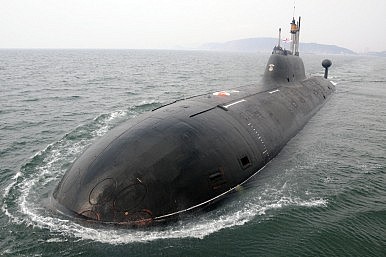
In December 2014, Russian President Vladimir Putin traveled to India, traditionally a major consumer of Russia-made military equipment. In New Delhi, Putin met Indian Prime Minister Narendra Modi and the two pledged to deepen their defense ties. During that visit, Russia’s trade minister, Denis Manturov, hinted that Moscow would eagerly lease a nuclear submarine to India if there was interest: “If India decides to have more contracts to lease nuclear submarines, we are ready to supply,” he noted India currently operates one Akula-II-class nuclear submarine, the INS Chakra, leased in 2011 from Russia for a 10 year period. The lease weighs in at $970 million, representing a considerable portion of India’s cumulative spending on Russian equipment.
The Russian minister’s comments were not entirely out of left field: Indian defense ministry officials had told the press that the Indian Navy would acquire another nuclear submarine from Russia. After December, information surrounding a potential second submarine lease died down — until this week. The Russia and India Report noted last week that a Russian shipbuilding industry source noted that “Russia is ready to lease a second Project 971 Shchuka-B submarine to India for a period of ten years.” The report continues:
In a separate report earlier last week from Russia's state-run TASS news agency a “high-placed source in the system of Russia’s military and technical cooperation with foreign countries” notes that ”In January this year, the Indian side suggested transferring the second project 971 multipurpose nuclear submarine Kashalot for lease.” He adds that ”the Russian side is studying the issue.” ”The procedure will most likely be similar to the procedure, which was used for transferring the first submarine called Nerpa to the Indian side,” TASS‘ source adds.
In addition to the INS Chakra, India is currently conducting sea trials for an additional nuclear submarine, the indigenously developed INS Arihant. India has an additional three submarines planned as part of the Arihant-class. The major distinction between India’s Akula-class and Arihant-class is that the latter is an SSBN and a critical part of ensuring a robust nuclear triad for New Delhi. The INS Chakra and the K-322 Kashalot are attack submarines, intended for anti-surface combat, sea-denial, and coastal defense purposes.
India’s submarine procurement plans were defined primarily by a thirty-year plan, conceived of in the late-1990s, which envisages a modernized submarine force consisting of submarines acquired in equal parts from the West and Russia, complemented by an indigenous design.
30 March 2015
In December 2014, Russian President Vladimir Putin traveled to India, traditionally a major consumer of Russia-made military equipment. In New Delhi, Putin met Indian Prime Minister Narendra Modi and the two pledged to deepen their defense ties. During that visit, Russia’s trade minister, Denis Manturov, hinted that Moscow would eagerly lease a nuclear submarine to India if there was interest: “If India decides to have more contracts to lease nuclear submarines, we are ready to supply,” he noted India currently operates one Akula-II-class nuclear submarine, the INS Chakra, leased in 2011 from Russia for a 10 year period. The lease weighs in at $970 million, representing a considerable portion of India’s cumulative spending on Russian equipment.
The Russian minister’s comments were not entirely out of left field: Indian defense ministry officials had told the press that the Indian Navy would acquire another nuclear submarine from Russia. After December, information surrounding a potential second submarine lease died down — until this week. The Russia and India Report noted last week that a Russian shipbuilding industry source noted that “Russia is ready to lease a second Project 971 Shchuka-B submarine to India for a period of ten years.” The report continues:
The submarine will be customized by the Amur shipyards. Modernization and testing of the submarine and training of the Indian crew will take three years. The Kashalot will be transferred to the Indian Navy in 2018, the source noted.The specific submarine to be leased is the K-322 Kashalot, an Akula-II-class submarine (Akula is the NATO reporting name for the Shchuka) with a surface displacement of 8,140 tons, submerged speed of 30 knots, and maximum operating depth of 520 meters. The Kashalot additionally requires a crew of 73 sailors and uses a 190 mW nuclear reactor for propulsion. The Kashalot features eight torpedo tubes in total, with four bays designed for 630 mm torpedoes and the remainder designed for 533 mm torpedoes (optimized for Russian-made Type 65 and Type 53 torpedoes).
In a separate report earlier last week from Russia's state-run TASS news agency a “high-placed source in the system of Russia’s military and technical cooperation with foreign countries” notes that ”In January this year, the Indian side suggested transferring the second project 971 multipurpose nuclear submarine Kashalot for lease.” He adds that ”the Russian side is studying the issue.” ”The procedure will most likely be similar to the procedure, which was used for transferring the first submarine called Nerpa to the Indian side,” TASS‘ source adds.
In addition to the INS Chakra, India is currently conducting sea trials for an additional nuclear submarine, the indigenously developed INS Arihant. India has an additional three submarines planned as part of the Arihant-class. The major distinction between India’s Akula-class and Arihant-class is that the latter is an SSBN and a critical part of ensuring a robust nuclear triad for New Delhi. The INS Chakra and the K-322 Kashalot are attack submarines, intended for anti-surface combat, sea-denial, and coastal defense purposes.
India’s submarine procurement plans were defined primarily by a thirty-year plan, conceived of in the late-1990s, which envisages a modernized submarine force consisting of submarines acquired in equal parts from the West and Russia, complemented by an indigenous design.
Subscribe to:
Posts (Atom)