Wednesday, April 1, 2015

China's "Great Wall of Sand" going up in South China Sea draws U.S. rebuke


Simon Denyer, Washington Post
1 April 2015


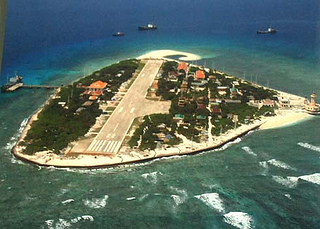
BEIJING – China is building “a great wall of sand” through an unprecedented program of land reclamation in the South China Sea, raising concerns about the possibility of military confrontation in the disputed waters, according to the commander of the U.S. Pacific Fleet.
Admiral Harry Harris Jr. told a naval conference in Australia late Tuesday that competing territorial claims by several nations in the South China Sea are “increasing regional tensions and the potential for miscalculation,” the Associated Press reported.
“But what’s really drawing a lot of concern in the here and now is the unprecedented land reclamation currently being conducted by China,” he said.
Satellite images show rapid construction on various coral reefs and rocks controlled by China within the disputed Spratly Islands, including harbors and piers, helipads, buildings and potentially at least one airstrip, experts say. Last month, State Department spokeswoman Jen Psaki expressed concerns that the program was an attempt to “militarize outposts on disputed land features.”
Harris said China had now created 1.5 square miles of artificial landmass in recent months.
“China is building artificial land by pumping sand onto live coral reefs – some of them submerged – and paving them over with concrete,” he said. In a region known for its beautiful natural islands, he said, “China is creating a great wall of sand with dredges and bulldozers over the course of months”.
China claims almost all of the South China Sea as its territorial waters, but its claims overlap with those of Vietnam, the Philippines, Taiwan, Malaysia and Brunei.
Last month, Foreign Minister Wang Yi said the country was merely carrying out “necessary construction on its own islands and reefs,” and said it would continue to uphold freedom of navigation in the busy shipping waters of the South China Sea, as well as resolve disputes through “direct dialogue” and consultation.
“The construction does not target or affect anyone,” he said at a news conference. “We do not accept criticism from others when we are merely building facilities in our own yard. We have every right to do things that are lawful and justified.”
State news agency Xinhua was more forthright in rejecting U.S. criticisms last month, accusing Washington of displaying a “perverted sense of insecurity” and a “pirate-style mindset.”
While China’s attention was focused elsewhere in previous decades, the other major claimants to the Spratly Islands occupied various islands and rocks throughout the archipelago, building ports, piers, bases and airstrips there. China now appears to be rushing to underline its own claims.
“This history matters a great deal, because what Washington and its friends and allies may see as punctuated, lightening-speed construction is likely viewed in China as a perfectly legitimate game of catch-up,” Mira Rapp-Hooper, director of the Asia Maritime Transparency Initiative and a fellow at the Center for Strategic and International Studies (CSIS) wrote in a recent report.
“What sets China’s activities apart, however, is that Beijing has been dramatically changing the size and structure of existing physical land features, while other claimants have built upon or modified existing land masses,” she wrote in a related report.
The only major claimant without an airstrip in the archipelago, China appears to be putting that right by turning the hitherto largely submerged Fiery Cross Reef into the largest island in the Spratlys, experts said. Reclamation work at several sites appears to have begun after President Xi Jinping took power in 2013.
Yanmei Xie, senior China analyst with the International Crisis Group in Beijing said island reclamation project was a deliberate strategic decision.
“Although China's exact intention is unclear so far, they are likely mainly designed to extend China's power projection, by expanding, for example, its surveillance, early warning and air interception capabilities further out into the sea,” she said. “With these added capabilities, China could have a de facto Air Defense Identification Zone in the South China Sea, even though it may not rush to declare one out of concern for the political and diplomatic fallout.”
China provoked strong U.S. criticism when it unilaterally declared an Air Defense Identification Zone over disputed waters in the East China Sea in 2013, and Secretary
of State John Kerry was among those who warned Beijing not to do the same over the South China Sea.
Harris said the pace of China’s construction of artificial islands “raises serious questions about Chinese intentions,” adding: “How China proceeds will be a key indicator of whether the region is heading toward confrontation or cooperation.”
Foreign policy experts said China’s activities would not reinforce its legal claims to the islands under the U.N. Convention on the Law of the Sea, since only natural land features are relevant to maritime rights. But it could help China enforce de facto control of some of the disputed waters.
Chris Johnson, a senior adviser at CSIS, said China had carried out more reclamation work on the islands in the past five months than other claimants had done in the past five years. “They want to be able to operate with impunity in these waters, and they want the rest of us to accept it,” he said.
“So what does the game plan ultimately entail? Is it to be able to move around in these areas and operate, and by doing so, in a de facto manner, emphasize their claims? Or do they have they have intent, over time, to kick rival claimants off?” he asked. “I don’t think there’s a sense of that, but I do think their behavior suggests they are moving in one direction, and they expect the other claimants to respect their growing power.”
Harris said the United States is on track to reposition 60 percent of its navy to the Pacific fleet by 2020. “By maintaining a capable and credible forward presence in the region, we’re able to improve our ability to maintain stability and security,” he said, according to the AP. “If any crisis does break out, we’re better positioned to quickly respond.”
But Johnson said the Chinese knew that the U.S. “toolkit” to deal with its actions was “somewhat limited,” and was exploiting that fact.
“We have the rhetorical messages, like the Admiral’s comments,” he said. “And then at the other end of the spectrum, we have the Seventh Fleet, which nobody really wants to use, or can’t figure out how to use in an effective way. And in between, there is not so much.”
Liu Liu contributed to this report.

Hanoi takes resistance to Beijing underwater

Vietnam bets on submarines, reviving Viet Cong-style guile against a bigger adversary

Andrew Browne, Wall Street Journal
1 April 2015


HANOI – To help vanquish a much stronger adversary, Viet Cong guerrillas fighting U.S. forces in the 1960s used an extensive network of tunnels on the outskirts of Saigon.
From deep underground, they launched surprise attacks. The booby-trapped networks withstood pummeling by B-52 bombers. U.S. Army scouts who wriggled inside spoke of descending into a “black echo.”
Now, faced with a new threat from China – this time at sea – Vietnam’s outgunned and outnumbered military is falling back on a similar tactic: It’s hiding underwater. Vietnam’s largest-ever arms purchase is a multibillion-dollar deal for six Russian submarines. The third arrived a few weeks ago, according to Vietnamese press reports. Superstealthy, the Kilo-class vessels are known in U.S. naval circles as “black holes.”
The subs, like the Viet Cong tunnels, are a prime example of asymmetrical warfare: They allow a weaker force to create uncertainty in the mind of a powerful opponent.
Vietnam’s submarine deal illustrates how countries in the region with no hope of matching China’s military power are looking for alternative ways to counter Beijing’s territorial ambitions, adding a new and unpredictable dimension to tensions over the South China Sea.
Subs prowling through shallow channels, in the hands of competing navies with little experience handling the complex systems, increases the risk for accidental encounters that could quickly escalate to suck in the U.S. and other major powers.
Chinese President Xi Jinping speaks in visionary terms about a “community of shared interests” in Asia-Pacific. At a regional forum on Saturday, he pledged to “jointly build a regional order that is more favorable to Asia and the world.”
But the South China Sea is a cauldron. China’s own newly constructed nuclear-submarine base on the island of Hainan gazes directly out over a stretch of sea reaching all the way to Indonesia that China increasingly regards as its maritime backyard.
For coastal states such as Vietnam and Malaysia and island nations like Indonesia, subs are among the most effective way to even the odds against China’s might. All feel threatened, but none are strong enough to go toe-to-toe against China’s military.
The Kilo-class subs will give Vietnam a “modest but potent” answer to Chinese naval intimidation, writes Carl Thayer, emeritus professor at the Australian Defence Force Academy.
Elsewhere in East Asia, South Korea and Japan also have formidable submarine forces. Australia plans to spend 50 billion Australian dollars (about U.S. $40 billion) on powerful new subs. The Philippines, Thailand and Myanmar are thinking of acquisitions. All this makes for an increasingly crowded seabed.
With subs, though, all it takes is one, lurking unseen, to alter the military equation.
Finding and destroying them is hard, and their attacks on shipping are almost always devastating. It is this combination that makes them so destabilizing. When subs are identified, ship commanders must make rapid life-or-death decisions on whether to shoot and risk an international conflict.
Moreover, this silent contest is now playing out in the depths of the world’s busiest sea lanes.
More than half of the world’s annual merchant-fleet tonnage passes through the South China Sea. It links the Western Pacific with the Indian Ocean; whoever controls it will have a tight grip on the global economy.
Vietnam, with its long coastline, is at the very heart of what has become a geopolitical struggle. Although its military is the most powerful in the 10-member Association of Southeast Asian Nations, it is also uniquely susceptible to pressure from Beijing: No Vietnamese leader can afford to get on the wrong side of China, especially not as Vietnam is becoming increasingly dependent on manufacturing work flooding in from China to take advantage of lower wages.
This is why, say military analysts in Hanoi, a crisis last May triggered by the arrival of a giant Chinese oil-drilling
rig in waters both countries claim has now been smoothed over.
But Vietnam’s vulnerability is also what draws in the great powers. It was no coincidence that Hillary Clinton, then the U.S. secretary of state, used a meeting on Asian security in Hanoi in 2010 to declare that a peaceful resolution of the South China Sea disputes was in America’s “national interest.”
That is also why the major powers are rallying around Vietnam’s submarine program. India is training Vietnam’s submariners; Japanese doctors are providing expertise on treating decompression sickness; America, having eased a ban on lethal-weapons sales to Vietnam, is offering to help enhance its maritime intelligence, which will make the submarines more effective.
America’s rationale for going to war in Vietnam in the last century was the “domino theory” – the idea that if Vietnam fell to communism its neighbors would follow. A similar logic drives the desire of the great powers to beef up Vietnam’s defenses, say regional defense analysts. If Hanoi disappears entirely into China’s orbit, the thinking goes, countering Beijing in the South China Sea will be that much harder.
Vietnam, though, knows it can’t count on America or any other nation for help if conflict with China breaks out. That’s a big reason it’s buying subs. As during its war with America, it knows its best defense lies in stealth and guile, which adds risk in already treacherous waters.

U.S. admiral delivers broadside to China

Brendan Nicholson, The Australian
1 April 2015

The commander of the U.S. Pacific Fleet has blasted China for its apparent efforts to fortify the disputed Spratly Islands by creating a "Great Wall of Sand" in the South China Sea.
Harry Harris said competing claims by several nations in the South China Sea were increasing regional tensions and the potential for miscalculation.
"But what's really drawing a lot of concern in the here and now is the unprecedented land reclamation currently being conducted by China," Admiral Harris said at the War Memorial in Canberra as a guest of the Australian Strategic Policy Institute.
"China is building artificial land by pumping sand on to live coral reefs – some of them submerged – and paving over them with concrete.
"China has now created over 4sq km of artificial landmass, roughly the size of Canberra's Black Mountain Nature Reserve."
China lays claim to much of the mineral-rich South China Sea, including areas also claimed by Brunei, Malaysia, The Philippines, Vietnam and Taiwan.
Last month, Janes Defence Weekly published satellite images of shallow reefs to which white sand outcrops had been added.
On those outcrops were what appeared to be Chinese military facilities, Janes said.
Admiral Harris said the Indo-Asia-Pacific region was known for its mosaic of beautiful natural islands, from the Maldives to the Andamans, from Indonesia and Malaysia, to the Great Barrier Reef and Tahiti.
"And I live in the beautiful Hawaiian Islands, in one of nature's great creations, a magnificent geography formed by millions of years of volcanic activity," he said.
"In sharp contrast, China is creating a great wall of sand with dredges and bulldozers over the course of months.
"When one looks at China's pattern of provocative actions towards smaller claimant states the lack of clarity on its sweeping nine-island line claim that is inconsistent with international law and the deep asymmetry between China's capabilities and those of its smaller neighbours, well it's no surprise that the scope and pace of building man-made islands raises serious questions about Chinese intentions.
"How China proceeds will be a key indicator of whether the region is heading towards confrontation or co-operation."
Like Australia, the U.S. had important ties to China.
"We're all hopeful that China will become a contributor to stability, not a source of insecurity, but as we like to say in navy circles, hope is not a strategy.
"So we also continue to constructively engage China, exploring new confidence building measures, while encouraging China to play a responsible role in supporting international rules and norms in the maritime domain."
The deputy commander of U.S. naval surface forces in the Pacific, Christopher Paul said Australia could add its new landing ships and Air Warfare Destroyers to U.S. "hunter-killer" groups to help repel aggressors in the region.
Admiral Harris said North Korea's refusal to apologise for sinking of one of the South's warships, Cheonan, five years ago and killing 46 sailors was a
powerful reminder that it remained a dangerous and unrepentant nation.
"It seeks nuclear weapons and a long-range missile system that can deliver them throughout the region," he said. "That, folks, keeps me up at night."
Australia was playing a leading role in global security.
"Our coalition fight against ISIL is a perfect example," he said.
"ISIL threatens all law-abiding, freedom-loving nations, including Australia. So I applaud Australia's leadership in this fight.
"The link between our two great democracies is as important to our future as it has been to our storeyed past. And that's why I remain committed to my part in deepening our defence relationship with Australia."

Boustead-DCNS joint venture secures submarine service


30 March 2015
Boustead DCNS Naval Corporation (BDNC) - a joint venture between BHIC Defence Technologies and French shipbuilder DCNS - has been notified of a contract extension to provide in-service support to the Royal Malaysian Navy's (RMN's) two Scorpene attack submarines.
The majority owner of BDNC, Boustead Heavy Industries Corporation (BHIC), said in a statement to the Bursa Malaysia stock exchange on 30 March that it had received a letter of acceptance from the Malaysian government to extend submarine support services until May 2017.
BHIC said the value of the contract extension was MYR531.2 million (USD143 million). The original submarine support contract was awarded in 2010 and was scheduled to expire later this year.

Former Florida Keys sub base during Cuban missile crisis goes on market for $21.2 million

Sean McCaughan/Curbed
30 March 2015

122 acres of the Florida Keys that was a Naval Air Station during the Cuban Missile Crisis, with a vast set of submarine pits,has hit the market for $21.2 million. On Boca Chica Key, the property has more than its fair share of old war stories, "and has a very colorful and distinct history", none of which the brokerbabble actually includes. Although there isn't anything left standing from the old base, at least according to the listing photos, the seven sub slips still remain. The water, from their deep drafts, is as blacky as ever. These 90-foot wide and 25-foot deep canals lead to a deep water basin that exits to the Florida Bay, and are the WWII-era centerpieces of a a whole lot of empty land that still exist around it. Then under the bridge that enters Key West you go and you're in the Atlantic Ocean... and Cuba.

China’s mini-submarine ‘making neighbors nervous’


By William Lowther/Taipei Times
1 April 2015

 China is designing a nuclear submarine that incorporates a mini-submarine that could be used to land special operations forces on nearby targets, such as Taiwan.
The Shang-class nuclear-powered attack submarine — known as Type-93T — has been reported over the past week by US media outlets and in Jane’s Defence Weekly.
The new nuclear submarine is apparently a version of an earlier boat that has been modified for coastal warfare, International Assessment and Strategy Center senior fellow in Asian military affairs Rick Fisher told the Taipei Times.
“Its distinctive features reportedly include a lock-out chamber aft the sail for housing a special operations forces transport vehicle,” Fisher said.
The big submarine might also have a six-blade propeller instead of the usual seven blades so that it can move more quietly in shallow waters and maneuver close to shore.
Fisher says that a Chinese invasion of Taiwan cannot succeed without the successful early landing of special operations forces to secure ports and airfields for follow-on troops.
“For Taiwan, countering the People’s Liberation Army (PLA) special operations forces threat will require much greater public education and enabling police and militia forces to respond immediately with superior firepower,” Fisher said.
He also said that some sources believe China has kept more than 20 of its Type-033 conventional submarines for transporting special operations forces to nearby potential targets, such as Taiwan.
It is conceivable that using the new nuclear-powered submarine with the mini-submarine attached, and also using conventional submarines, that the PLA could put 2,000 “very effective special operations troops on Taiwan to facilitate early invasion objectives,” Fisher said.
“These forces could very effectively attack coastal targets or quickly don disguises to attack military or political targets inland,” he said.
Jane’s Defence Weekly reported that in addition to the mini-submarine facility, the new nuclear submarine has four sonar areas along the side of the boat and fixtures for a towed sonar array.
“It is making neighbors nervous,” US Naval Institute News said.

DARPA to test 'submarine' drone that takes off from the ocean

This undated photo obtained March 29, 2015 from the Defense Advanced Research Projects Agency (DARPA) shows a prototype Submarine Hold at RisK (SHARK) unmanned underwater vehicle (UUV) during deep-sea testing for DARPA’s Distributed Agile Submarine Hunting (DASH) program. (AFP/DARPA)

This undated photo obtained March 29, 2015 from the Defense Advanced Research Projects Agency (DARPA) shows a prototype Submarine Hold at RisK (SHARK) unmanned underwater vehicle (UUV) during deep-sea testing for DARPA’s Distributed Agile Submarine Hunting (DASH) program. (AFP/DARPA)

rt.com
1 April 2015

This year, the Pentagon’s advanced research projects department will start testing their new “submarine” drone, which can lie in wait on the ocean floor for years before ever being launched into the skies.
The new drones, being developed by the Defense Advanced Research Projects Agency (DARPA), are part of a new focus by the US military in developing and improving technology for emerging threats.
These deployable, unmanned systems and sensors can theoretically lie on the deep-ocean floor for years at time in anticipation of the US Navy’s need for non-lethal assistance. When needed, the deep-sea nodes can be activated remotely and recalled to the surface.