Thursday, April 2, 2015

Norway reverts to Cold War mode as Russian air patrols spike

Andrew Higgins, New York Times
2 April 2015

BODO, Norway – From his command post burrowed deep into a mountain of quartz and slate north of the Arctic Circle, the 54-year-old commander of the Norwegian military’s operations headquarters watches time flowing backward, pushed into reverse by surging Russian military activity redolent of East-West sparring during the Cold War.
“I am what you could call a seasoned Cold Warrior,” the commander, Lt. Gen. Morten Haga Lunde, said, speaking in an underground complex built to withstand a nuclear blast. As a result, he added, he is not too alarmed by increased Russian military activity along NATO’s northern flank.
“It is more or less the same as when I started,” said General Lunde, who began his career tracking Soviet warplanes as a Norwegian Air Force navigator in the early 1980s.
After a long hiatus following the December 1991 collapse of the Soviet Union, when Moscow grounded its strategic bombers for lack of fuel, spare parts and will to project power, President Vladimir V. Putin’snewly assertive Russia “is back to normal behavior,” General Lunde said.
Last year, Norway intercepted 74 Russian warplanes off its coast, 27 percent more than in 2013, scrambling F-16 fighters from a military air base in Bodo to monitor and photograph them. This is far fewer than the hundreds of Soviet planes Norway tracked off its coast at the height of the Cold War. However, last year’s total was a drastic increase from the 11 Russian warplanes Norway spotted 10 years earlier.
In Norway, a country that takes pride in championing peace – witnessed in its brokering of pacts between Israelis and Palestinians and its awarding of the Nobel Peace Prize – what General Lunde called the “new old normal” has come as a jolt. It has set off debate over military spending and highlighted how quickly Mr. Putin has shredded the certainties of the post-Cold War era.
“Russia has created uncertainty about its intentions, so there is, of course, unpredictability,” Norway’s defense minister, Ine Eriksen Soreide, said in an interview in Oslo, adding that the military was being restructured to deal better with new risks, particularly in the Arctic.
Nobody expects Russia to invade. So far, its warplanes have taken care not to stray into Norwegian airspace, unlike in the Baltics, where they regularly violate borders.
But the spike in Russian military activity along Norway’s coast has added an unexpected measure of verisimilitude to a new television thriller called “Occupied,” which, based on an idea by Norway’s pre-eminent crime writer, Jo Nesbo, explores how the country would respond to conquest by Russia. The multipart series is scheduled to air in September. When Mr. Nesbo first proposed the idea years ago, he was told it was much too far-fetched.
Russia has itself fed the scaremongering with bursts of belligerent language, like the recent comment by Moscow’s ambassador to Copenhagen that Danish warships “will be targets for Russia’s nuclear weapons” if Denmark contributes radar to a Europe-based missile defense system planned by NATO. Denmark’s foreign minister, Martin Lidegaard, dismissed the threat as “unacceptable.”
Russia’s muscle-flexing is due in part simply to the fact that the country is spending more on its military and has re-established abilities eroded during the post-Soviet chaos of the 1990s. When Mr. Putin first became president in 2000, Russia spent $9.2 billion on its military, but this has since risen 10 times and will increase again this year despite a slumping economy, hammered by a collapse in the price of oil and also by Western sanctions.
“The signal they are sending is that the situation in the 1990s was an exception,” General Lunde said.
Jens Stoltenberg, a former Norwegian prime minister who became NATO’s secretary general late last year, said that Russia’s new assertiveness was not just a result of increased funding and revived ability. He said it was also “part of a broader picture where we see that Russia is willing to use force,” most notably in Georgia in 2008 and, more recently, in Ukraine.
“It is this total picture that gives us reason for concern,” Mr. Stoltenberg said.
Ukraine, he added, is very different from Norway, which is a member of NATO. Ukraine is outside the alliance and has no prospect of joining any time soon. However, Mr. Stoltenberg said, Norway and other NATO countries that share a border with Russia also have to deal with Russian efforts to “intimidate its neighbors,” no matter what their status.
Russian air activity along the borders of NATO, the northern parts of which are patrolled by fighters based in Bodo, increased 50 percent from 2013 to last year, according to the alliance. At the same time, Russia sharply increased so-called snap military exercises, training maneuvers that, in violation of established procedure, were either announced at the last minute or kept secret.
One such exercise was used to cover Russia’s furtive seizure of Crimea in March 2014, but most seem aimed simply at showing NATO that Russia is back as a serious power. Among those was an exercise held last month across from Norway’s northern border with Russia – just a week after Norwegian forces held their own, much smaller exercise, Joint Viking, which was announced two years in advance.
Katarzyna Zysk, a researcher at the Norwegian Institute of Defense Studies, said Mr. Putin had emphasized strengthening Russia’s military presence in the Arctic; equipping the Northern Fleet, based in Murmansk, with new nuclear submarines; setting up a string of bases along the vast northern coast; and reopening abandoned Soviet-era military facilities like the base at Alakurtti, close to Finland.
Norway, she said, “does not count for Russia as Norway, but only as a member of NATO.”
“For them, it is the door to NATO,” she continued.
This link, she said, has made Russia particularly suspicious of Svalbard, a demilitarized cluster of Norwegian-controlled islands in the high Arctic that Moscow believes serves as a platform for eavesdropping and other covert activities by NATO.
While neither Russia nor Norway officially views the other as a direct threat, “the potential for inadvertent escalation is very serious,” Ms. Zysk said.
On at least one occasion, a Russian warplane has come dangerously close to hitting a Norwegian aircraft in what some see as a pattern of reckless flying. In January, two Russian Tu-95 bombers flew down the Norwegian coast and then, their transponders turned off, crossed into the English Channel, playing havoc with civilian air traffic and prompting the Royal Air Force to scramble.
If anything, however, Russia’s behavior has undermined its one clear and constant long-term objective: the weakening of NATO, which the Kremlin’s chief propagandist, Dmitry K. Kiselyov, described last year as a “cancerous tumor” that must be removed.
Norway, along with all but three other European members of NATO, still spends less than 2 percent of its gross domestic product on its military, the target that all 28 members of the alliance are supposed to meet.
But Ms. Soreide, the defense minister, said Norway had stopped cutting and would increase military spending this year by 3.3 percent, despite economic troubles caused by the collapse in the price of oil, Norway’s principal export.
Russia is “not viewed as a military threat,” she said, but it has changed the rules of the game by creating so much uncertainty about its intentions. “Until a threat arrives at your doorstep, you don’t know what will happen,” she added.
Finland, traditionally nonaligned and outside the alliance, has grown so concerned by Russia’s new approach that it has in recent months floated the idea of joining NATO, previously a taboo topic. Prime Minister Alexander Stubb has said he would like Finland to join the alliance one day, and this has growing, but still minority, support from a once deeply hostile public, according to opinion polls.
Russia’s assertiveness has also prodded NATO to strengthen its presence in the Baltics, where new alliance members like Estonia have no air force of their own but now host regular rotations of warplanes from other members, including Poland and Britain, to patrol the skies.
NATO’s tightening bonds are on display daily at the Bodo air base, where Norwegian fighter pilots, idled for years by the absence of Russian planes to follow, once again have a sense of purpose. A busy NATO outpost during the Cold War, Bodo served as a hub for U-2 spy plane flights over the Soviet Union. Francis Gary Powers, the U-2 pilot imprisoned in Moscow in 1960, was on his way to Bodo when his plane was shot down.
But once the Soviet Union unraveled, Bodo fell into the doldrums, leaving Norwegian fighter pilots with nothing much to do.
“After the Berlin Wall came down, everything was very quiet,” said the veteran commander of the 331st Air Squadron, whose F-16 fighters are on round-the-clock alert as part of NATO’s air defense network. “Now it is a lot more interesting.”
Linked by secure telephone to the Combined Air Operations Center of NATO in Uedem, Germany, his squadron gets a call whenever Russian planes appear off the Norwegian coast and then has only 15 minutes to get airborne.
“It is like doing extreme sports,” the commander said, speaking on the condition of anonymity because of military rules. He described a special thrill in being able to get close to and photograph new Russian aircraft, adding that he had been the first to take a picture of Russia’s Su-34, a new fighter bomber. “That was very exciting,” he said.
“We are now getting back to the normal way of thinking,” the squadron commander added.
But he questioned whether public opinion had caught up with the fact that a predictable post-Cold War era of East-West comity was now over. “The problem in Norway is that we are so rich, fat and happy that we are not worried enough,” he said.

Taiwan submarine program interests 20 companies from Europe

China Post
2 April 2015

TAIPEI -- Several European companies have expressed interest in working with Taiwanese shipbuilders on Taiwan's submarine program, a senior military officer said Wednesday.

In response, Navy Chief of Staff Vice Adm. Hsiao Wei-min said that some local shipbuilding companies have expressed interest in carrying out the overhaul program.
The Navy is assessing these companies' abilities to conduct the project and is discussing with them details of the project, Hsiao said.
Meanwhile, Pu said that the Navy has an ultimate goal of building an indigenous submarine in cooperation with local shipbuilders. The overhaul program for the aging training subs could be a first step before a move to build submarines, he added.
The Navy has been in talks with domestic shipbuilders on a home-grown submarine program to replace its aging diesel-electric submarines, the officers said, and a design of the submarine is expected to be completed between 2016 and 2019.
In 2001, then-U.S. President George W. Bush proposed selling Taiwan eight diesel-electric submarines, but this was blocked by the Kuomintang-controlled Legislature in the mid-2000s after a budget request was made by the then-ruling Democratic Progressive Party administration in 2004.

  Little progress has been made on the project since then, prompting Taiwan to seek its own solution.

Duck drone is the U.S. Navy's new flying, swimming sub hunter


Duckhunt for Red October


Flying WANDA Flimmer
United States Naval Research Laboratory

The fastest way to move a submarine is through the air. At least, that’s the logic behind “Flimmer,” a new flying and swimming duck drone currently in development by the Naval Research Laboratory. Profiled in the winter issue of Spectra, the NRL’s magazine, Flimmer may go beyond a weird name and become a powerful submarine-tracking tool.
While it might be inspired by a duck, Flimmer certainly isn’t built like one. It has fins hidden on the ends of its wings, like a cubist's suggestion of what duck-ness might really be. In flight, these fins fold upwards to stabilize the craft, and a pusher propeller at the back of the Flimmer provides thrust. In the water, the rear fins, as well as a second pair further up the body, steer the robot. Flimmer can not only fly through the air and swim, but it can make the transition between the two easily. On smooth seas, it can land like a seaplane, but for rougher conditions where that’s not possible, Flimmer will dive into the water like a duck.
The latest version of Flimmer is an aerodynamic fish called the Flying WANDA. (WANDA comes from the Navy’s fish-mimicking “Wrasse-inspired Agile Near-shore Deformable-fin Automaton,” and, presumably, is named after a 1988 John Cleese film). In tests, WANDA could go as fast as 57 miles per hour while flying, and just 11 miles per hour in the water.
The Naval Research Lab only hints at future submarine-hunting plans for the Flimmer, conceptualizing the design as a more mobile and a re-deployable sonobuoy. Sonobuoys are, like the name suggests, sonor-carrying buoys, usually dropped from planes to scan an area for submarines. Once deployed, they’re static devices. While they can communicate their findings back to human operators, sonobuoys just sort of float where they are. If they detect a submarine and then it goes away, there’s not much a sonobuoy can do. But a Flimmer, with sonar mounted in its belly, could move around to keep looking for the submarine.
Not bad, for a duckbot.

Washington's regional ambitions center stage in Australian submarine tender

* U.S. military supports Australia buying Japanese submarines
* Move would tighten links between the three Asia-Pacific navies
* Other competitors in the project are from Germany and France
* A$50 bln deal is largest defence project in Australian history


By Matt Siegel

ADELAIDE, Australia, April 2 (Reuters) - Washington's strategic ambitions in Asia are looming large over Australia's multi-billion dollar tender for new submarines, giving Japan a possible edge over competitors from Germany and France, defence and industry sources said.
Although the United States had little presence at a conference last week in Adelaide convened to discuss the project, the enthusiasm U.S. commanders have shown for Canberra buying Japanese submarines was one of the hottest topics behind the scenes.
Such a purchase would bind the U.S., Japanese and Australian navies more tightly together in the face of China's rapid military modernisation and growing assertiveness in Asian waters.
It would also give Japanese Prime Minister Shinzo Abe, whose more muscular security agenda is supported by Washington, his first major weapons export deal after he lifted a ban on overseas arms sales last year.
That would boost Japan's defence industry and potentially pave the way for the sale of advanced Japanese weapons to countries such as the Philippines and Vietnam that are at loggerheads with Beijing over the disputed South China Sea, sources at the conference said.
Australian defence officials have acknowledged that compatibility with the U.S. navy will be an important factor in choosing the winning bid.
"The level of Australian industry involvement will be a fundamental consideration, as will interoperability with our alliance partner, the United States," Defence Minister Kevin Andrews told the conference.
A Defence Ministry spokesman, asked to comment further, said capability, cost and schedule were also important.
Sources at the conference said choosing Japan would give Australia a high-tech submarine and possible access to sensitive technology to boost its own shipbuilding industry if the boats were built in Australia.
It would also allow Canberra to cement its outsized role in regional affairs by partnering with a country that has a long-standing security alliance with the United States.
The qualitative difference between the various submarines on offer was negligible, Rex Patrick, a former advisor to the previous defence minister and a submarine expert, told Reuters.
"All these guys build a good submarine. It will be factors other than capability which determines who wins," he said, partly referring to Washington's geo-strategic goals in Asia.
COMPETITION GROWS
Competition is heating up for Australia's biggest defence procurement, worth A$50 billion ($38 billion) over the life-cycle of the submarines.
Japan had been the frontrunner to replace Australia's ageing Collins-class submarines with an off-the-shelf version of its 4,000-tonne Soryu-class vessel after Prime Minister Tony Abbott agreed to cooperate on military technology with Abe last June.
But during an internal challenge to his leadership in February, Abbott promised something closer to an open tender to be completed by the year-end in an attempt to shore up political support.
That opened the door to Germany's ThyssenKrupp Marine Systems (TKMS) and France's state-controlled naval contractor DCNS, which have both said they would build submarines in Australia, where manufacturing jobs have been disappearing. The makers of the Soryu-class boats are Mitsubishi Heavy Industries and Kawasaki Heavy Industries .
U.S. officials insist they are not pressing Australia to buy any particular submarine but say they see benefits from the interoperability of the Japanese option.
During a visit to Australia in February, General Martin Dempsey, chairman of the U.S. Joint Chiefs of Staff, said the decision was one Australia would have to make on its own "for any number of domestic and international reasons".
But Dempsey also cited "interoperability" among allies as a key factor, although experts at the conference noted that submarines built by Germany and France, both NATO members, can communicate with U.S. vessels.
Still, Washington's view is that the Japanese submarine is technically superior to any European-made vessel, and will allow for the integration of more U.S. technology, a senior U.S. military source told Reuters.
"If they want to do it right, it is a Japanese hull and propulsion plant, with a U.S. combat system and ISR package," he said, using an acronym for the various types of intelligence, surveillance and reconnaissance sensors like sonar and radar used on U.S. submarines.

SHARED VALUES
One notable Japanese participant at the conference, retired Vice Admiral Yoji Koda, told Reuters that Japanese-Australian cooperation on the submarine deal would ensure countries in the Asia-Pacific with common values such as democracy also shared a common defence capability.
"The key point is not exporting our equipment on an industrial basis, but to be more strategic," added Koda, who also said Tokyo should be flexible and build most of the vessels in Australia, which would make the deal politically more palatable for Abbott.
Until now, sources had said Japan was reluctant to engage in a tender partly to avoid getting embroiled in a bidding war.

Japanese industry is also seen as wary of undertaking significant construction in Australia because of concerns about its sensitive submarine technology, including its stealthy propulsion system and advanced welding techniques.

Wall Street Journal: Pakistan submarine deal won't please India


A couple of weeks ago, after a visit to India, I wrote an op-ed for the Indian weekly Open with my impressions of the Indian strategic debate. The biggest take-away was how openly suspicious the Indians are about China and its intentions in the Indian Ocean.
That suspicion got another boost yesterday, with Islamabad announcing that it has approved, in principle, the purchase of eight Chinese submarines for the Pakistan navy.

This is big news for a number of reasons. First, it's a large order for a navy that currently only operates five submarines. Second, it will be the first time China has exported its submarines, which says something about the improvements in its military technology (granted, Pakistan is probably buying on price as well as capability, but this is a navy that has previously bought advanced European submarines, so its not an undiscerning customer).
And third, it represents a fairly blunt Chinese statement about its willingness to cooperate with Pakistan to challenge Indian maritime power. Of course China has sold arms to Pakistan before, and in fact it helped Pakistan develop its nuclear and ballistic missile programs. China has also sold surface ships to the Pakistan Navy in the past. But in the maritime domain, it is fair to say that this is a step-change in China's involvement with the Pakistan military.
Things are likely to get even more discomfiting for India soon, with Xi Jinping set to visit Pakistan from 10 April, where he will address parliament. The Newspaper Dawn writes:
Sources say that during the visit, over two dozen memoranda of understanding (MOUs) regarding nuclear power, the Gwadar Port, the Pak-China Economic Corridor (PCEC), energy, trade and investment will be signed by Pakistan and China.
It will be interesting to hear what is announced on the Chinese-developed Gwadar Port, which has been cited in India as an example of Beijing's attempt to encircle India with naval bases, and also as a way for China to avoid maritime choke points in the Indian and Pacific oceans by moving Persian Gulf oil and gas over land from Gwadar to China. This theory has been debunked in the past, partly on the grounds that the port is not supported by sufficient road and rail infrastructure, but this might be set to change.

Pakistan OKs plan to get 8 submarines from China

This photo shows a Chinese navy submarine. — AP/File

By Muhammad Bilal/dawn.com
31 March 2015

ISLAMABAD: Naval officials informed the Standing Committee on Defence Monday that the federal government has endorsed a summary to get eight submarines from China.
Pakistan's military has long been a major importer of defence equipment, particularly from key ally China.
After the Cold War ended Pakistan began to deepen defence and economic ties with China.
The committee was informed that Secretary of the Economic Affairs division Muhammad Saleem Sethi would be leaving for China tomorrow where the issue is expected to come under discussion.
The officials also said that the national security committee will give the final nod to go ahead with the plan to get eight submarines from China.
"Other proposals are under consideration as well. The Pakistan navy is also in touch with Germany, Britain and France to purchase used submarines," officials informed the committee.
Keeping in view the level of threat and the present status of submarines, naval officials said Pakistan needed the latest submarines.
The naval officials also revealed that France had refused to provide submarines to Pakistan.
They said there seemed to be various reasons behind France's refusal to sell submarines to Pakistan — including an issue of technology transfer. On the other hand, they said France was selling its submarines to India.
The naval officials rejected some committee members' concerns that Chinese technology was not of satisfactory quality.They said there was no such issue at hand as JF-17 has proven to be a world class military jet.
The officials informed the standing committee that Pakistan's defence relations with Russia were also improving.
On the other hand, there appeared to be a divide among committee members whether Pakistan should send troops to Saudi Arabia.
Defence Secretary Lieutenant General (retd) Alam Khattak said that the Pakistan Army would abide by the government's decision on whether to send troops to Saudi Arabia to partake in a military campaign in Yemen.
This was the first time that the defence secretary spelled out the official stance of the Pakistan Army on sending troops to Saudi Arabia to partake in a military campaign in Yemen.
His brief comment came in response to a volley of questions by committee members as to whether military troops would be sent to the Saudi kingdom.
Chairman Sheikh Rohail Asghar maintained that the Pakistan Army should chase terrorists regardless of their location but women members belonging to the Muttahida Qaumi Movement (MQM) and Awami National Party (ANP) had a different point of view.

Wednesday, April 1, 2015

Taiwan's largest missile ship goes into service


Agence France-Presse, Mar 31

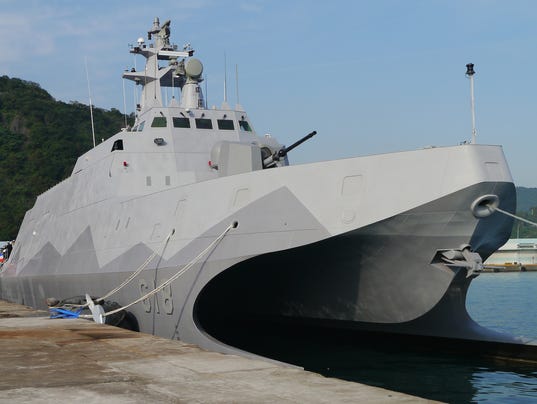
KAOHSIUNG, Taiwan – Taiwan's largest-ever missile ship went into service Tuesday after a ceremony presided over by President Ma Ying-jeou as the island strives to modernize its military in response to a perceived threat from China.
Ma praised the corvette's "stealth and speed" at the ceremony involving hundreds of naval officers and said it "reflects the determination by the military to defend national security.”
Armed with 16 missiles, the ship will strengthen Taiwan's defense capabilities. China still considers the island part of its territory waiting to be reunited – by force if necessary.
The 500-tonne corvette, named 'Tuo Chiang' ('Tuo River'), will be deployed following the ceremony at the southern Tsoying naval base.
It is the prototype for up to 11 others to be built for the navy.
The sleek twin-hulled ship uses stealth technology to reduce the reflection of radar waves, making it harder to detect.
Taiwan in December announced a new project to produce advanced homegrown surface-to-air missiles from 2015 as part of efforts to build an air defense shield.
It has also announced a move to build its own submarines, which Ma said Tuesday were "crucial" to its defense.
The Taiwanese navy currently operates a fleet of four submarines, but only two of them can be deployed in the event of war. The other two were built by the United States in the 1940s and are too old for combat.
Relations between Taiwan and China have improved since 2008 when Ma, of the China-friendly Kuomintang party, came to power.
However the perceived threat remains – according to Taiwan's defense ministry China has more than 1,500 ballistic and cruise missiles trained on the island.